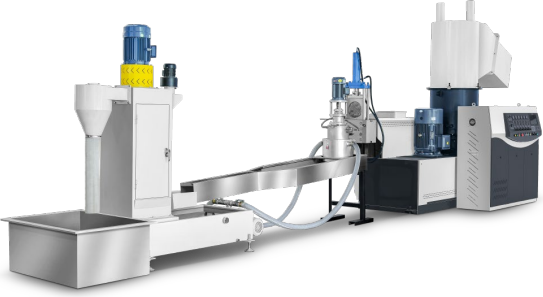
1. Circular Economy & In-House Scrap Recovery
In modern plastic converting plants, edge trim, setup roll scrap, and defective bags represent 5% to 12% of total raw material throughput. Implementing a high-efficiency plastic recycling pelletizing line allows factory owners to achieve a zero-waste closed-loop manufacturing model, converting factory scrap into clean, uniform plastic pellets.
2. Cutter Compactor vs Conventional Hopper Feeding
Traditional recycling systems require pre-shredding film scrap before feeding into an extruder hopper. Ashal CX Series recycling lines utilize an integrated cutter compactor unit directly connected to the extruder barrel. High-speed rotating knives shred soft film scrap, generate frictional heat to pre-dry and densify the polymer, and force-feed semi-molten material into the extruder screw at constant velocity.
3. Dual-Stage Vacuum Degassing Architecture
Printed scrap film and post-consumer plastics contain residual moisture, printing inks, organic contaminants, and volatile solvents. Without adequate venting, trapped gas causes porosity, bubbles, and brittle mechanical properties in recycled pellets. Ashal twin-vent vacuum degassing chambers extract volatile gases under high vacuum (-0.09 MPa), ensuring high-density, bubble-free pellets.
4. Non-Stop Hydraulic Screen Changer Technology
Melt filtration removes paper fibers, dust, and non-melting contaminants. Ashal dual-bolt hydraulic screen changers feature double filtration channels. During screen replacement, one channel remains open in the melt stream while the dirty screen is replaced, enabling continuous production without stopping the extruder main motor.
5. Granulation Systems: Water-Ring vs Strand Cutting
Water-ring die-face pelletizing cuts molten polymer strands immediately at the die plate inside a surrounding water mist ring. The cut pellets are flushed into a centrifugal dewatering dryer, achieving final moisture content under 0.5% for instant reuse in film blowing lines.